

Keep the Dying out of Hospital,
Save $200M/Year With Excellent Care
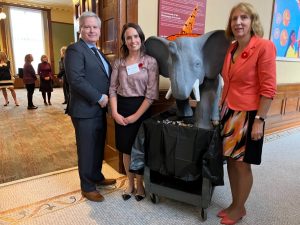
Rick Firth (President & CEO, HPCO), Julie Aube (Executive Director, Maison McChulloch Hospice), MPP France Gélinas.
Monday October 31, 2022
The Elephant in the Room was back at Queen’s Park for the first in-person MPP Day since 2019. One-on-one meetings were held with more than two dozen MPPs and many more attended a lunch hour Hallowe’en themed pizza party. A statue of “Ellie” the elephant acted as a photo booth for MPPs and helped reinforce that memories are made right to the end of life.
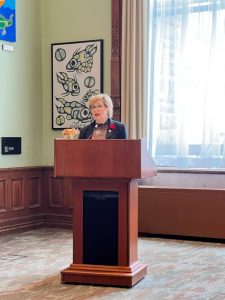
MPP Robin Martin addressing the attendees of the lunch reception.
The event was co-sponsored by MPPs from each party caucus, with speeches being given by Robin Martin, Parliamentary Assistant to the Minister of Health, NDP Health critic France Gélinas, Interim Liberal Leader John Fraser, and Green Party Leader Mike Schreiner. All spoke of strong support for the hospice sector. Each party also made a point of introducing HPCO and its visiting teams in the Legislature and, during Question Period, MPP Gélinas asked the Health Minister when hospices could expect funding from the Government. (See transcript below)
As the Government moves into early Budget planning stages, HPCO noted that the Government could continue to preserve and increase hospital capacity, find cost efficiencies, and provide the right care in the right place by adopting three key recommendations for annual funding increases to:
1. Cover all clinical costs in hospice residences
2. Better support at home visiting hospice services
3. Support and expand grief and bereavement services
“We’re all going to die, and we’re all losing loved ones. And now more than ever people need the right care in the right place at the end of life, as well as support with loss and grief.” HPCO President and CEO Rick Firth told MPPs and their staff. “Hospice is about helping people live well right to the end of life. Anyone who has experienced hospice care with a loved one knows that dying and loss need not be a frightening and negative experience, it can be a healing and memorable time.”

Interim leader of the Ontario Liberal Party MPP John Fraser posing with Ellie the Elephant.
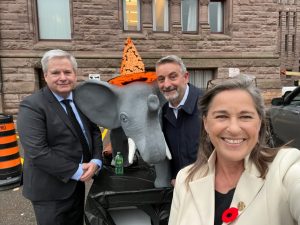
Rick Firth (president & CEO, HPCO), Minister Paul Calandra (House Leader, Minister of Long-Term Care), Jennifer Mossop (GR Advisor, HPCO)
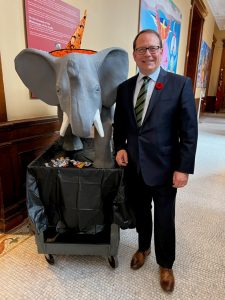
Green Party of Ontario leader MPP Mike Schreiner posing with Ellie the Elephant.
Transcript of MPP France Gélinas’ Comments:
Mme France Gélinas:
Bonne Halloween. Ma question est pour le premier ministre.
Members of Hospice Palliative Care Ontario are at Queen’s Park today. Their message is really clear: Annualized operating funding increases are needed now to prevent the collapse of the lower-cost, highly valued hospice sector.
Does the Premier think that palliative care patients should do grocery shopping, cook their own food, wash their own dishes? Does he think that they should change their own bed and do their own laundry? Does he think that they should clean their room, wash the floor, take their trash to the curb? Does he think that palliative care patients should pay for heat, hydro, telephone, cable, Internet? Then why is it that the Premier does not fund any of these basic services in Ontario hospices?
The Speaker (Hon. Ted Arnott): Member for Eglinton–Lawrence.
Mrs. Robin Martin: Thank you to the member opposite for the question. This government, this Premier and the Ministry of Health are committed to supporting high-quality palliative end-of-life care for all Ontarians who need it, and I think we’ve done more than any government in recent history to support that initiative.
In 2019-20, the ministry provided Hospice Palliative Care Ontario with $1.7 million in additional funding over two years to support initiatives related to advance care planning. In October 2021, Ontario introduced a one-time investment of $23 million in hospice residences across the province to help them continue to provide high-quality, compassionate end-of-life services and care to people and their loved ones during the COVID-19 pandemic.
The ministry is also supporting new hospices across Ontario by contributing to the cost of operating and constructing new and existing facilities. This government is making historic investments in palliative and end-of-life care, and we will continue to do so.
The Speaker (Hon. Ted Arnott): Supplementary question.
Mme France Gélinas: The government funds 50% of the operating cost of our hospices. The community-funding model that the hospices depend on is broken. The words “hospice palliative care” are nowhere in the last budget that this government tabled. The reality is that the costs continue to escalate while community donation power is challenged by economic realities, including the pandemic.
Hospices are not only a pressure valve for emergency room crises, but they’re an access point for grief, for bereavement, for mental health services. Members of Hospice Palliative Care Ontario are here to remind us that hospice palliative care means system savings and efficiencies. It means improved patient care and caregiver experience. Nobody should spend their last day alive washing dishes.
Can your government commit today to funding hospices to a minimum of 70% of their operating costs?
Mrs. Robin Martin: Thank you again to the member opposite. Again, I would say our government has done a lot to support palliative care and end-of-life care in Ontario. In December 2021, thanks to the great work of the member from Niagara West-Lincoln, the ministry introduced the Provincial Framework for Palliative Care, following his Compassionate Care Act, as a tool to help provide better-connected care across the province and guide future work to ensure all Ontarians receive the respect, dignity and care that they deserve at every stage of their life and across the continuum of care. The province has increased dedicated investments in hospice expansion and palliative care quality improvement initiatives, from $67 million in 2018 to over $74 million in 2022.
This government and Ministry of Health recognize the important role that hospices play in helping people live well from the time of diagnosis to a terminal illness at the end of life and while grieving a death. We continue to look for other opportunities to work with and implement the province’s palliative care framework and to work with Hospice Palliative Care Ontario.
,